Format
Remote, with live mentor support
Outcome
Validated prototype, UX case study and a documented AI workflow
Language
English
Duration
9 weeks, part-time, 2–5 hours per week
Format
Remote, with live mentor support
Outcome
Validated prototype, UX case study and a documented AI workflow
Language
English
Duration
9 weeks, part-time, 2–5 hours per week
 Figma
Figma Material Design
 Notion
Tools change. We teach a stack and the judgement to pick the right tool per phase, so you can swap any one of them out and keep working.
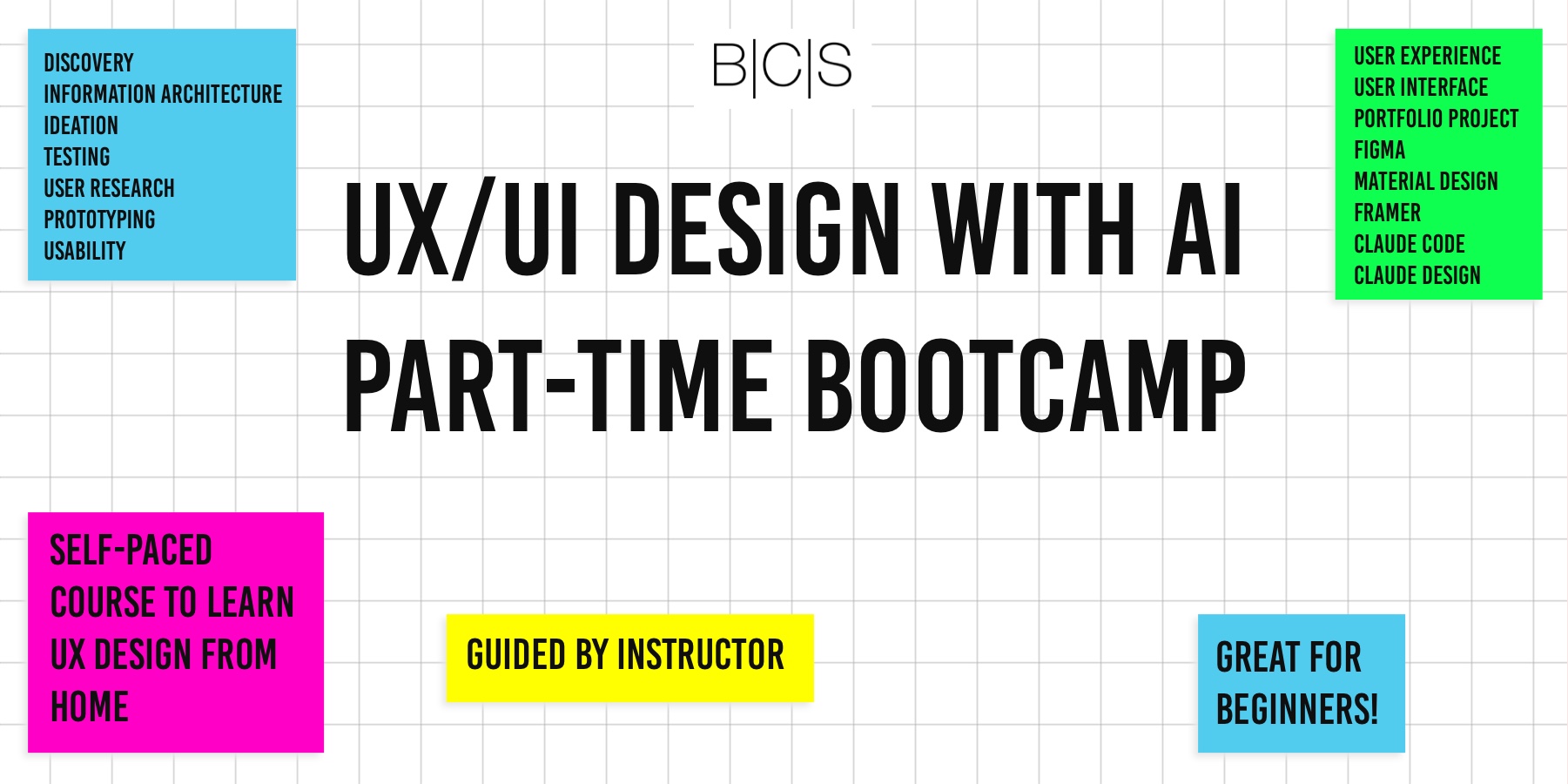
Work through a complete UX project from idea and research to prototype and validation.
Get weekly 1:1 video sessions plus ongoing feedback via chat, so you stay on track and improve at every step.
Learn practical UX methods used in real product teams – applicable to design, product, development, and business roles.
The UX job market changed shape. “AI-assisted design workflows” moved from a nice-to-have line on a CV to something hiring managers ask about in the first interview – and something founders and product teams now expect by default.
A designer who cannot work this way competes at a permanent disadvantage, against people who ship three concepts in the time they ship one.
But the opposite failure is just as fatal. Portfolios full of generic AI output – no research, no testing, no point of view – get rejected in seconds.
This course sits between those two failures: rigorous, evidence-based UX methodology, executed at AI speed, with the quality control to prove the thinking is yours. One project, nine weeks, one mentor watching every decision.
You run a single real project from idea to case study. Every week is one phase of it, with a 1:1 mentor session to review what you produced. Click a week to open it.
Alongside the project you build a professional AI method – the part that does not exist in a traditional UX course, and the part that makes the difference in an interview.
Chain-of-thought, few-shot and role-based prompting, structured output formats – how to get repeatable, high-quality results instead of lucky one-offs.
Your project runs for nine weeks. You learn to manage context windows, project instruction files and progressive disclosure so the model stays coherent about your product, your users and your standards from week one to week nine.
Using AI for visual exploration properly – feedback loops between prompts and images, with the model as a collaborator in moodboarding and ideation rather than a slot machine.
Generating mid- and high-fidelity screens with Claude Design and Figma AI, then steering and correcting them like a designer rather than accepting the first output.
The single biggest reason AI-assisted portfolios get rejected. Explicit rules and quality rubrics that keep generated work specific, branded, accessible and recognisably yours.
LLM-as-a-judge checks and testing loops to catch errors before your users do, plus bias, guardrails and why human oversight is non-negotiable in a design process.
There is no separate “AI week”. Each phase uses AI where a working designer would actually use it – and skips it where a human still does it better.
Real interviews, a real survey, real usability sessions. AI helps you synthesize the data. It does not get to invent it.
An explicit method for keeping generated work specific, branded and accessible – and for spotting when a model has produced something plausible but empty.
Weekly 1:1 sessions cover not just the screens but how you got there – the prompts, the context you gave the model, and what you chose to throw away.
Nine weeks on the same product means you hit the problems that only appear at depth – including keeping an AI coherent about your project over weeks.
Most portfolios fail on the write-up, not the pixels. The last week exists only to turn your work into a story a hiring manager reads to the end.
You build products but don’t always have design support.
Learn how to make better UX and UI decisions using structured methods instead of guesswork.
You have a product idea and want to build something people actually need.
Learn how to validate ideas, research users, and plan your product before development.
You work with designers and developers and want to contribute more to product decisions.
Understand the UX process and decision-making to collaborate more effectively.
You want to move into UX but cannot stop working for nine weeks full-time.
Build a portfolio-ready case study with a current AI workflow in 2–5 hours a week, around your job.
You can make things look right, but decisions still come down to taste.
Move beyond aesthetics into research-backed, validated design decisions – the part of the job AI does not do for you.
You use AI daily but the workflow is improvised and the results are uneven.
Replace it with a professional method: context engineering, reproducible workflows, quality rubrics and evaluation loops.
If you want to have a discovery call to see which course is better for you and your goals please feel free to book a call or meeting on campus. We'd be happy to help you!
Or just call us: +34 936 639 807
One-time payment to register for the course.
Instalment payments are available at the checkout by  and PayPal.
| Mo | Tu | We | Th | Fr | Sa | Su |
|---|---|---|---|---|---|---|
Weekly 1:1 sessions, support platform, chat channel
After enrolling, you’ll get access to materials, meet your mentor, define your project, and start building – step by step, with AI in the workflow from week one.
Please choose a starting date first
I had an amazing time at Barcelona Code School. Anyone who is looking for intensive and proactive course I would really recommend it, it helps you to be ready for the job market!
My time at Barcelona Code School was life changing in the best way. Chris is so knowledgeable, kind and talented, and his constant encouragement really highlighted my strengths, and inspired me to face (and overcome) my fears as a newbie UX/UI designer. He never allowed me or my fellow students to indulge in self doubt, and I believe it's because of this that we were able to overcome any design challenges we encountered in the most fun and meaningful way.
It was truly a pleasure to have him as an instructor and I'll forever be grateful for his constant encouragement, and for believing in me from day one and even after completing the program. He also has an awesome sense of humour and excellent music taste! A big thank you to the BCS team ☺️☺️ I too highly recommend this course!
I completed a 9-week UX/UI Design Bootcamp Course at Barcelona Code School, and it exceeded my expectations. The course transformed my design thinking and approach. The teaching methods were excellent, and I learned a lot.
A special thanks to my instructor, Chris Kelly—he’s patient, dedicated, and ensures every student understands and applies the material effectively.
I highly recommend this course and the amazing team at Barcelona Code School!
Every digital product today competes on user experience. It’s not enough for apps and websites to work – they need to be intuitive, efficient, and built around real user needs.
UX design is the process behind that – combining research, psychology, and structured problem-solving to create products that people actually use and businesses can grow with.
AI has made it trivially cheap to produce interfaces. It has made it more valuable than ever to know which interface is worth producing – and that judgement is exactly what does not automate.
This course teaches you how to apply that process in practice – so you can design, test, and improve real products using proven UX methodologies, at the speed an AI-assisted workflow makes possible.
You don’t need any previous experience to start. The course is designed to take you from zero to a solid, job-ready foundation in UX design.
You’ll learn step by step – from user research and problem definition to prototyping and testing – with a clear structure and continuous guidance. You use AI from week one, so it never becomes a scary add-on.
With small groups and personalized mentorship, you won’t get stuck or fall behind. You’ll build skills, confidence, and real projects throughout the program.
All you need is a laptop and commitment. We’ll guide you through the rest.
If you already have experience in design, development, or product roles, you’ll be able to build on your existing skills and structure them with UX methodology.
The course will help you move beyond visuals and intuition into research-driven, validated design decisions – the key difference between design and UX.
And if you already use AI daily, this is where the improvising stops: context engineering, reproducible workflows, quality rubrics and evaluation loops – a method you can bring into a team.
You’ll work on more complex challenges, refine your process, and create portfolio projects that demonstrate how you think and solve problems.
We can assist in getting a student loan which usually has lower rates than consumer loans.
We can send you a proforma invoice for the selected course which you can attach to the student loan application.
Please fill out this form.
Instalment payments are available at the checkout by and PayPal.
It can be Mac or Windows.
English.
For the course you do not need Spanish. Everybody at our school speaks English.
Beginners. If you don't know what UX design is, this course is for you. If you already know some basics, that will help too.
Claude and Claude Design, Figma and FigJam with their AI features, plus Notion and Google Forms for research operations. More importantly, you learn the judgement to evaluate and adopt whatever replaces them next year.
No. You drive the AI tools in plain English. No programming experience is required and none is assumed.
That is the most common failure of AI-assisted portfolios and we treat avoiding it as a core skill. You learn explicit anti-slop rules and quality rubrics, and the whole project is grounded in your own research and usability testing – which is exactly what generic AI output can never fake.
You learn the complete UX process – research, definition, information architecture, prototyping, usability testing, iteration. AI is how you execute it faster, not a replacement for knowing it. The fundamentals are the part that keeps working when the tools change.
Most of the work can be done on free tiers, but a paid plan for your main assistant makes the longer project phases considerably smoother. Your mentor will advise you on the setup before you start.
Yes. We send you materials to study to come prepared.
Our course is mentored. You work 1:1 with an instructor who is available via chat and weekly video calls, so you are not left alone with your questions.